
There is a conversation that does not happen often enough in Cape Town’s commercial property world. It is not about which alarm system to install or whether to upgrade the CCTV. It is the harder, more honest question: is the security service protecting your building actually qualified, legal, and good enough to hold up when something goes wrong?
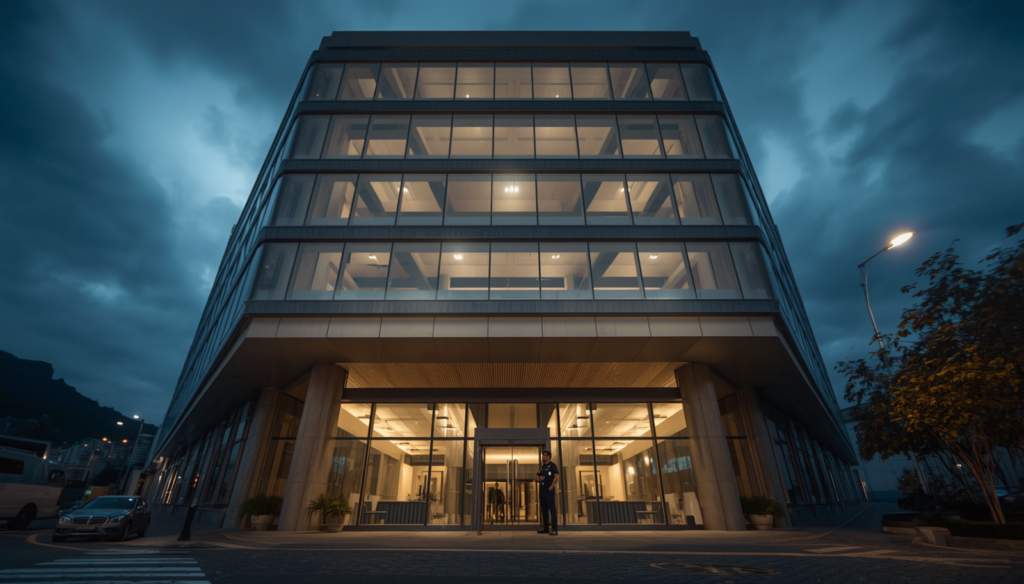
Autumn in Cape Town is the season when that question becomes most urgent and least often asked. The summer rush is over. Budgets are being reviewed. Some commercial properties are between tenants. Others are running on contracts signed eighteen months ago without a single review. And outside, the days are getting shorter, the weather is turning, and the conditions that make Cape Town commercial buildings vulnerable are quietly stacking up.
This article is for the property manager overseeing an office park in Century City, the warehouse owner in Montague Gardens, the landlord with a partially vacant retail strip in Bellville, and every business operator in between who has not thought critically about whether their current security guards to protect buildings are up to the task ahead.
Because if they are not, the consequences can be far more serious than a broken window.
The Real Security Challenges Facing Cape Town Commercial Buildings Right Now
Let us start with what is actually happening at Cape Town commercial properties this time of year, because the picture is more complicated than most building owners realise.
The first challenge is the compliance gap, and it is bigger than the industry likes to admit. South Africa’s private security industry has grown dramatically over the past decade, with more registered companies than ever. But alongside legitimate, professional operators, the industry is under serious threat from non-compliant fly-by-night operators who use untrained, unregistered individuals as security guards, often because they have identified the security industry as a quick way to make money in a crime-ridden country. These companies win contracts by undercutting compliant providers on price. They can do this because they skip training costs, pay below-minimum wages, and simply do not bother with PSIRA registration.
The businesses that hire them often have no idea they are doing anything wrong, until something goes wrong.
The second challenge is the building-specific risk that generic security packages simply do not address. A security service designed for a retail forecourt in Brackenfell is not the same as one needed for a multi-tenant office park in Claremont. Yet many commercial properties across Cape Town are operating on cookie-cutter security arrangements where the same patrol schedule, the same post orders, and the same number of security guards cover a wildly different set of risks and access points. When the plan does not match the building, gaps appear. Criminals are very good at finding those gaps.
The third challenge is vacancy and transitional occupancy, and autumn is when it bites hardest. When commercial buildings are empty between tenants, or partially occupied during a lease transition, they become targets. Winter in Cape Town brings cold, wet conditions that drive opportunists toward vacant structures. Copper stripping, vandalism, squatting, and arson are documented risks at unguarded vacant commercial properties. Insurers know this, which is why many commercial property policies require documented evidence of active security measures on vacant premises. Property owners who assume their standard alarm system is sufficient have often discovered too late that it is not.
The fourth challenge is the internal dimension that gets ignored in nearly every building security conversation. External crime draws attention. Internal theft does not. Yet the data is unambiguous: a substantial proportion of inventory and asset losses at commercial properties come from within, from employees, contractors, delivery personnel, and others with legitimate access who exploit that access because the oversight is not there. Security guards physically present at a loading bay, monitoring a service entrance, or conducting visible patrols in a warehouse changes that risk calculation entirely.
The fifth and perhaps most consequential challenge is legal liability. Cape Town’s courts, up to and including the Constitutional Court, have established clear precedents around what happens when inadequate security leads to harm on a commercial premises. Businesses that cannot demonstrate they took reasonable, documented precautions face both civil liability and insurance repudiation. In a city with a crime index that places it among the highest in the world, the legal expectation on commercial property owners to maintain genuine security is not theoretical. It is enforceable.

When Building Security Falls Short
It is one thing to describe the problem. It is another to sit with what it actually costs when it is not addressed.
Start with the compliance risk. Under the PSIRA Act, any person who knowingly or without the exercise of reasonable care contracts for the rendering of security services from a non-compliant provider is guilty of an offence. The consequences can include substantial fines, legal action, and criminal charges against the directors or trustees responsible for the contracting decision. This is not a remote risk. PSIRA and SAPS conduct joint operations targeting non-compliant security companies and their clients, with hundreds of criminal cases opened in recent years. Autumn is a time when many building managers are reviewing and renewing contracts. Signing a new contract with a non-compliant provider at this point is one of the most preventable risks in commercial property management.
Move to the physical consequences. A commercial building without proper security guards to protect it during transitional or vacant periods faces a predictable sequence of events. First, opportunistic trespassers test the perimeter. Then vandalism follows. Then copper or other high-value materials are stripped. Then structural damage makes the property uninhabitable and devalued. Insurance policies that seemed comprehensive turn out to contain clauses requiring active manned security on vacant commercial premises, and claims are repudiated. What started as a decision to save on security costs during a quiet period between tenants ends in losses that dwarf the security service fees avoided.
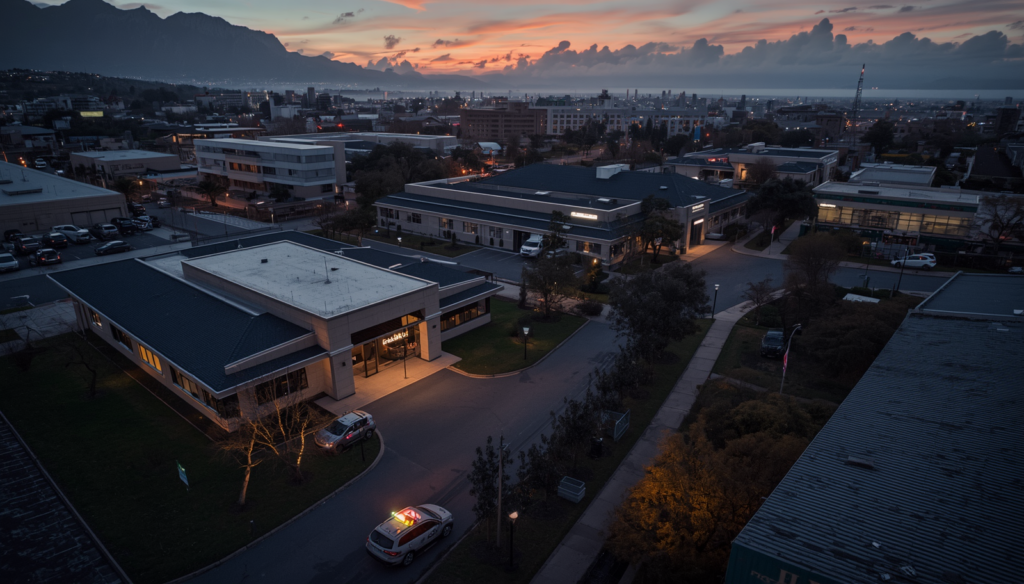
Then there is the liability question. When a customer is assaulted in a poorly lit parking structure, when a delivery driver is robbed in an unsupervised service yard, when an employee is harassed by an unknown intruder who gained access through an unmonitored entry point, the question of whether the building owner took reasonable precautions becomes the defining issue in any legal or insurance proceeding. South African courts have been clear that reasonable precautions mean documented, professionally managed, and actively monitored security. Good intentions and a camera that recorded the incident but did not prevent it are not reasonable precautions.
For multi-tenant buildings specifically, the consequences of inadequate security service ripple across every occupant. A single incident in a shared lobby, parking area, or common corridor affects every tenant’s perception of the building. Lease renewals become difficult. Vacancy rates rise. The building’s reputation in Cape Town’s commercial property market, a market that is always watching, takes a hit that takes years to recover from.
Securing Cape Town Commercial Buildings the Right Way
The good news is that building security is not complicated to get right when you follow a clear process. Here is a practical framework that any Cape Town commercial property owner or manager can apply.
Verify PSIRA compliance before anything else.
Before evaluating any security company Cape Town has to offer, verify their PSIRA registration and request the individual registration documents for all security guards to be deployed on your site. This takes fifteen minutes and costs nothing. A legitimate security guard company provides this documentation immediately and without resistance. If a provider stalls, deflects, or tells you this information is proprietary, treat that as a decisive signal to keep looking. PSIRA compliance is the minimum standard, not a bonus feature.
Demand a site-specific security assessment.
Generic security deployments are one of the main reasons commercial buildings remain exposed despite having a security contract in place. A reputable security company Cape Town will conduct a proper site assessment before proposing a deployment plan. That assessment should identify every entry and exit point, map the high-risk zones within and around the building, review current camera and lighting coverage, note seasonal vulnerabilities including winter weather effects on perimeter infrastructure, and result in a written plan that is specific to your property. If a security company’s proposal looks identical to what they offer every other client, it is not a site-specific plan.
Match security guards’ deployment to building activity patterns.
Security guards to protect buildings need to be deployed according to when and how those buildings are actually used, not according to a standard contract template. A multi-tenant office building with staggered arrival and departure times has different peak-risk periods than a single-tenant warehouse. A partially vacant property between tenants needs a different presence than a fully occupied one. Review your guard post assignments, shift times, and patrol routes against your building’s actual usage patterns. Misalignment between guard deployment and building activity is where most preventable incidents occur.
Establish a formal vacant property security protocol.
If any portion of your building is currently vacant or likely to become vacant during the April-to-August period, formalise a security protocol specifically for those spaces now. This should include scheduled physical inspections by security guards, documented perimeter checks, maintenance of all lighting and alarm systems in vacant sections, and a clear escalation path for any signs of access attempts. Do not assume that an alarm system covering an occupied wing of your building is also covering an adjacent vacant section. Verify this explicitly with your security service provider.
Create a documented liability trail.
One of the most pragmatic things a commercial property owner can do is treat security documentation as a legal asset. Keep records of your security company’s PSIRA registration, the specific security guards assigned to your site and their credentials, your patrol reports, your incident logs, and any site assessments conducted. If your property ever faces a legal or insurance challenge related to a security incident, this documentation is what demonstrates that you took reasonable precautions. A professional security guard company maintains this documentation as a matter of course. A non-compliant one almost certainly does not.
Why Experience and Reputation in a Security Guard Company Are Not Optional
When commercial property owners in Cape Town evaluate security companies, the temptation to lead with cost is understandable. Security service fees are a fixed overhead, and when a provider offers a lower quote, the saving looks attractive on a budget spreadsheet.
But the calculation is wrong, because it does not price in what the cheaper provider cannot provide.
A security guard company with thirty years of experience securing Cape Town commercial properties, residential estates, construction sites, and industrial yards has something that a newer or non-compliant operator simply cannot offer: proven, documented operational depth. That depth shows up in how they train and supervise their security guards, how they respond when a guard calls in sick at 2am during a winter storm, how they handle an incident on your premises in a way that protects you legally and operationally, and how they communicate with you as a client in the days and weeks and months after the contract is signed.
Security companies are not a commodity. The uniformed presence at your building’s entrance may look similar regardless of who provides it. What is different is everything that sits behind that presence: the training standard, the PSIRA compliance record, the management oversight, the standby coverage, the documented patrol verification, the incident reporting, and the institutional knowledge of Cape Town’s commercial crime patterns that informs where and when risks are highest.

SAS Security Services brings over thirty years of that depth to Cape Town commercial property security. As a fully PSIRA-compliant security guard company, SAS provides managed security guard services that are site-specific, professionally supervised, and accountable at every level. Whether your building is a single-tenant commercial premises, a multi-occupancy office park, a partially vacant property transitioning between leases, or an industrial yard with complex access management needs, the SAS approach starts with a proper assessment of what your building actually requires and builds from there.
Autumn is the right time to have that conversation, before winter tests every gap in your current security arrangement.
Frequently Asked Questions
- What makes security guards to protect buildings different from other types of security deployments?
Building security guard deployments are specifically designed around fixed premises with defined perimeters, multiple access points, and a mix of occupied and unoccupied spaces that change in risk profile at different times of day and night. Unlike mobile response services or retail loss prevention guards, security guards to protect buildings are tasked with physical access control, perimeter patrol, visitor management, incident reporting, and the kind of sustained visible deterrence that keeps a commercial property from becoming a target in the first place. The deployment plan must be tailored to the specific building’s layout, usage patterns, tenant mix, and seasonal vulnerabilities. A generic guard arrangement is not building security. It is the appearance of building security, which is not the same thing.
- How do I verify that a security company Cape Town is legally compliant before signing a contract?
Ask directly for the company’s PSIRA registration certificate and the individual PSIRA registration documents for every guard to be deployed at your site. You can also verify registration independently through the PSIRA website at psira.co.za using the company’s PSIRA number or the ID numbers of individual guards. A compliant and reputable security guard company will provide this documentation without hesitation. Additionally, ask whether the company is a member of the Security Association of South Africa, as SASA membership requires independently verified compliance with all industry and national legislation. Confirm that the company carries appropriate indemnity and liability insurance, and ask for references from similar commercial property clients in Cape Town.
- Why is autumn a particularly important time to review building security in Cape Town?
April and May represent a transition point across multiple dimensions that all affect building security simultaneously. Days shorten, increasing the hours of darkness around business opening and closing times, which elevates after-hours risk. Cape Town’s rainy season begins, compromising CCTV visibility, perimeter lighting, and physical infrastructure like fencing and gates. Commercial properties with expiring leases or transitional tenancy create periods of partial vacancy that attract opportunistic crime, including squatting and vandalism. Budgets are reviewed in autumn, which creates the practical window to renegotiate or upgrade security service contracts before winter conditions create active vulnerabilities. Acting in April or May is preventative. Acting in June or July after an incident is reactive and far more costly.
- What are the legal risks for a Cape Town commercial property owner who uses a non-PSIRA-compliant security service?
The PSIRA Act establishes that any person who knowingly or without the exercise of reasonable care contracts for security services from a non-compliant provider is guilty of a criminal offence, with potential consequences including substantial fines, penalties, and imprisonment. Beyond criminal exposure, non-compliant security arrangements create serious civil liability risk. If a security incident occurs on your premises and it emerges that your provider was not PSIRA-registered, courts and insurers will treat your security arrangement as inadequate regardless of how it appeared to function day to day. Insurance claims can be repudiated. Civil damages claims for harm suffered on your premises become significantly harder to defend. For directors and trustees of commercial buildings, the personal exposure is considerable, as their decision to engage a non-compliant provider can constitute a direct violation of their fiduciary duties to the property and its occupants.
- How many security guards does a commercial building in Cape Town typically need?
There is no universal answer, because building security is site-specific. The relevant variables include the number and type of entry and exit points, the building’s footprint and floor plan, the hours of operation, whether the building has day and night occupancy or is unoccupied for extended periods, the number of tenants and their individual access requirements, the crime profile of the surrounding area, and the seasonal risk adjustments relevant to Cape Town’s winter conditions. A single-tenant office building with one entrance and monitored parking may be adequately served by one or two guards on specific shifts. A large multi-tenant industrial park with multiple access gates, a service yard, and a 24-hour operation may require a significantly larger, structured deployment with a clear supervisory chain. The starting point is always a proper site assessment by a reputable security guard company, not a price per head calculation.
Ready to have an honest conversation about whether your Cape Town commercial building is truly protected this autumn? Contact SAS Security Services for a site assessment and security service review. Over 30 years of protecting Cape Town’s commercial properties, and counting.
Cape Town’s rainy season brings hidden security risks. Discover why autumn is the time to review your security guard service – read our recent article here…